For companies running Delphi · Objective-C · Firebird · old .NET

We’ll tell you exactly what’s wrong with your legacy system in two weeks.

Two senior engineers read your code, then hand you an architecture map, a risk list ranked by what breaks first, and three options with real effort estimates — so you can finally get a straight answer about what modernizing actually costs.

Fixed price. Two weeks. No obligation to do anything afterwards.

No commitment

It ends when the report does

You are not signing up for a modernization project. You’re buying an answer. Take it to another team if you like — plenty do.

Founders only

The engineer reading your code is on the first call

No middle agency layer, no bench of juniors. You get both co-founders on the call — the one managing delivery and the one reading your code.

Fixed scope

Two weeks, one report, no code written

Scope is written down before we start. We don’t quietly turn a two-week audit into a six-month engagement.

The problem

Nobody can quote you honestly, because nobody has read the code.

You ask three vendors what it costs to modernize your system. You get three numbers between $40,000 and $250,000, none of which are based on anything. So you do nothing for another year, and the system gets one year harder to fix.

The estimate is a guess wearing a suit

An agency spends ninety minutes on a call, looks at a folder structure, and produces a number with a decimal point in it. The number is wrong. Everyone knows it’s wrong. It gets approved anyway, and the overrun starts in month three.

“We’d recommend a full rewrite”

Of course they would — it’s the biggest possible project. Rewrites are where legacy systems go to die: the estimate doubles, the old system keeps running anyway, and two years later you’re maintaining both.

Nobody will touch Delphi or Objective-C

The shops that would take the work don’t have anyone who’s written a line of it since 2015. The ones who could have retired. Your role has been open for four months for a reason.

You need a big commitment to find out anything

Discovery is bundled into a six-figure contract. To learn what you’re dealing with, you have to already have decided.

What we do instead

Read the code first. Then quote.

It’s not complicated. It’s just that almost nobody is willing to spend two weeks finding out before they tell you a number.

Estimates come from the actual codebase

We open it, build it, read it, and write down what’s there. Every number in the report is traceable to something we saw, and the assumptions behind it are written next to it.

Three options, not one recommendation

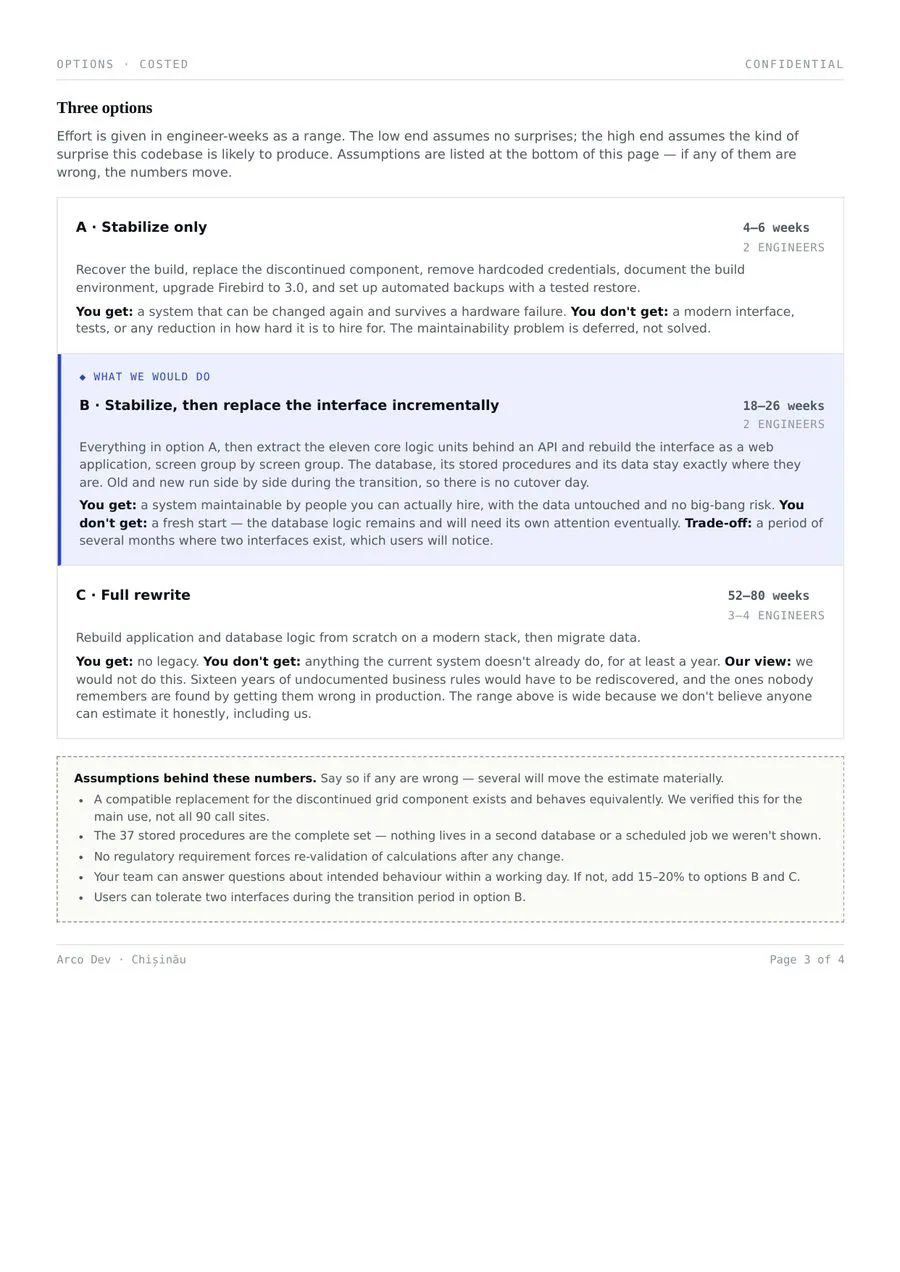
Stabilize, modernize incrementally, or rewrite — each with effort ranges and what you give up. Rewrite is usually the wrong answer, and we’ll show you why in your specific case.

We actually write Delphi and Objective-C

Accounting, invoicing, warehouse and admissions systems in Delphi and Firebird since 2007. Native iOS in Objective-C since 2010, including two years at Endava. This is the work we’re rare at, not the work we tolerate.

The report is yours, unconditionally

Take it to your internal team, to another vendor, or to your board. It’s written to be useful to whoever reads it, including someone who isn’t us.

The deliverable

“So what do I actually get at the end of it?”

A written report of roughly 15–25 pages, a one-page summary for whoever controls the budget, and a 90-minute call to walk through it.

  • 01
    Does it still build? The first question, and one that about half of abandoned systems fail. Broken dependency trees, missing SDKs, expired certificates, build scripts that assume a machine nobody has anymore. If the answer is no, that alone is worth knowing.
  • 02
    Architecture map What modules exist, how they talk to each other, where the business logic actually lives, and what’s dead. Diagrams, not paragraphs.
  • 03
    Language and framework audit For mixed codebases: how much is Objective-C versus Swift, where the bridging sits, what the interop debt looks like. For Delphi: version, component dependencies, what’s still supported. This is the number that tells you what modernization costs.
  • 04
    Compliance and platform risk For mobile: minimum SDK requirements, privacy manifests, deprecated APIs — whether the app can still be updated in the store at all. For desktop and server: OS and runtime end-of-life dates. The part with a clock on it.
  • 05
    Dependency and security review Abandoned libraries, known vulnerabilities, hardcoded credentials, tokens in plaintext, sensitive data in logs. We find something almost every time.
  • 06
    What your users are already telling you Where a public app is involved: store reviews read and grouped by technical cause. It’s a free bug list most companies never look at.
  • 07
    Three options, costed Stabilize, modernize incrementally, or rewrite — with effort ranges, what each one buys you, and what it doesn’t. Assumptions written down beside every number.
  • 08
    A 90-day plan for the option we’d pick Sequenced, with the riskiest unknown scheduled first rather than last.

Three pages from a sample report

Anonymized, but representative — a Delphi and Firebird system in production since 2009. This is the shape of what lands in your inbox.

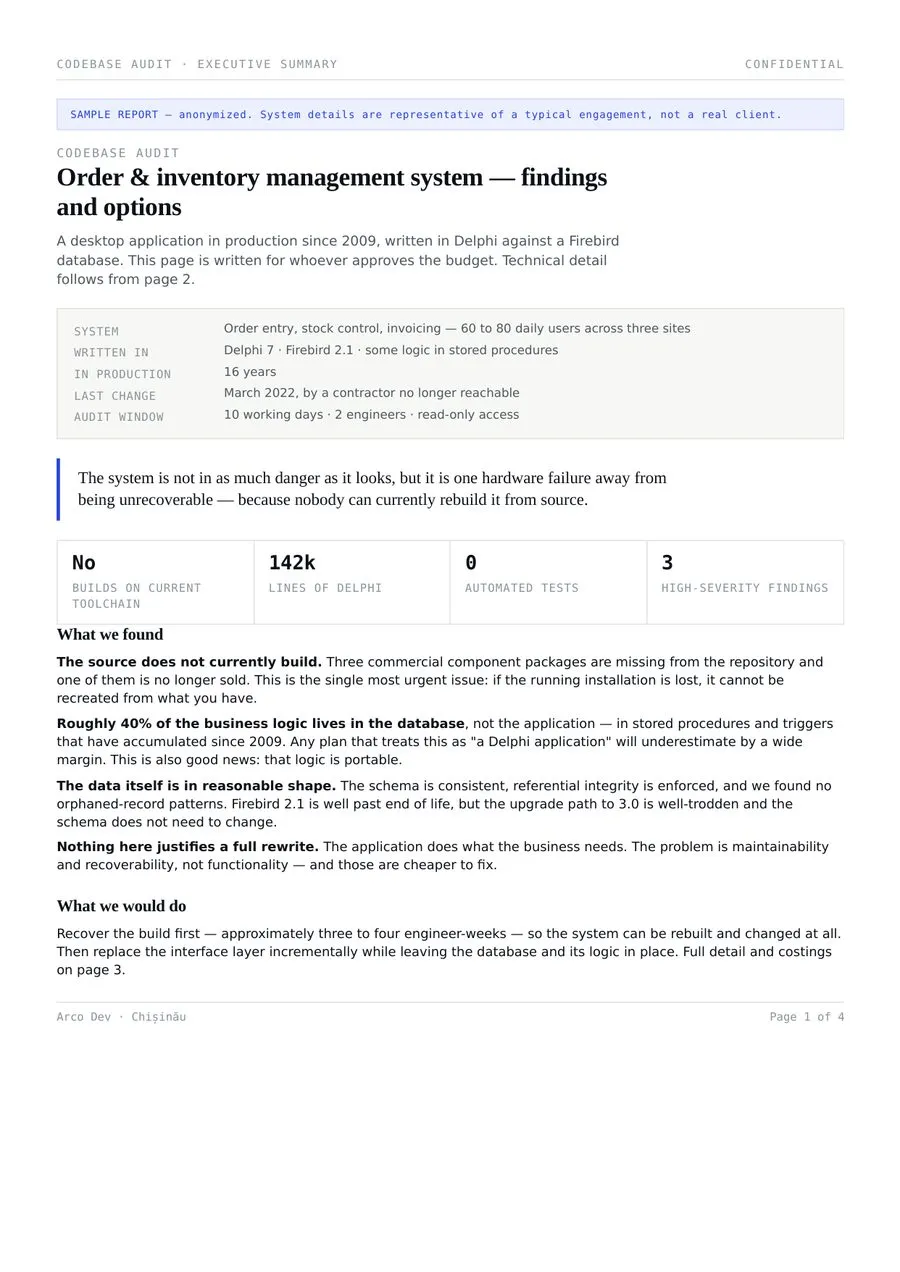
Executive summary page of a sample codebase audit report
The one page for your boardFindings in plain language, no jargon
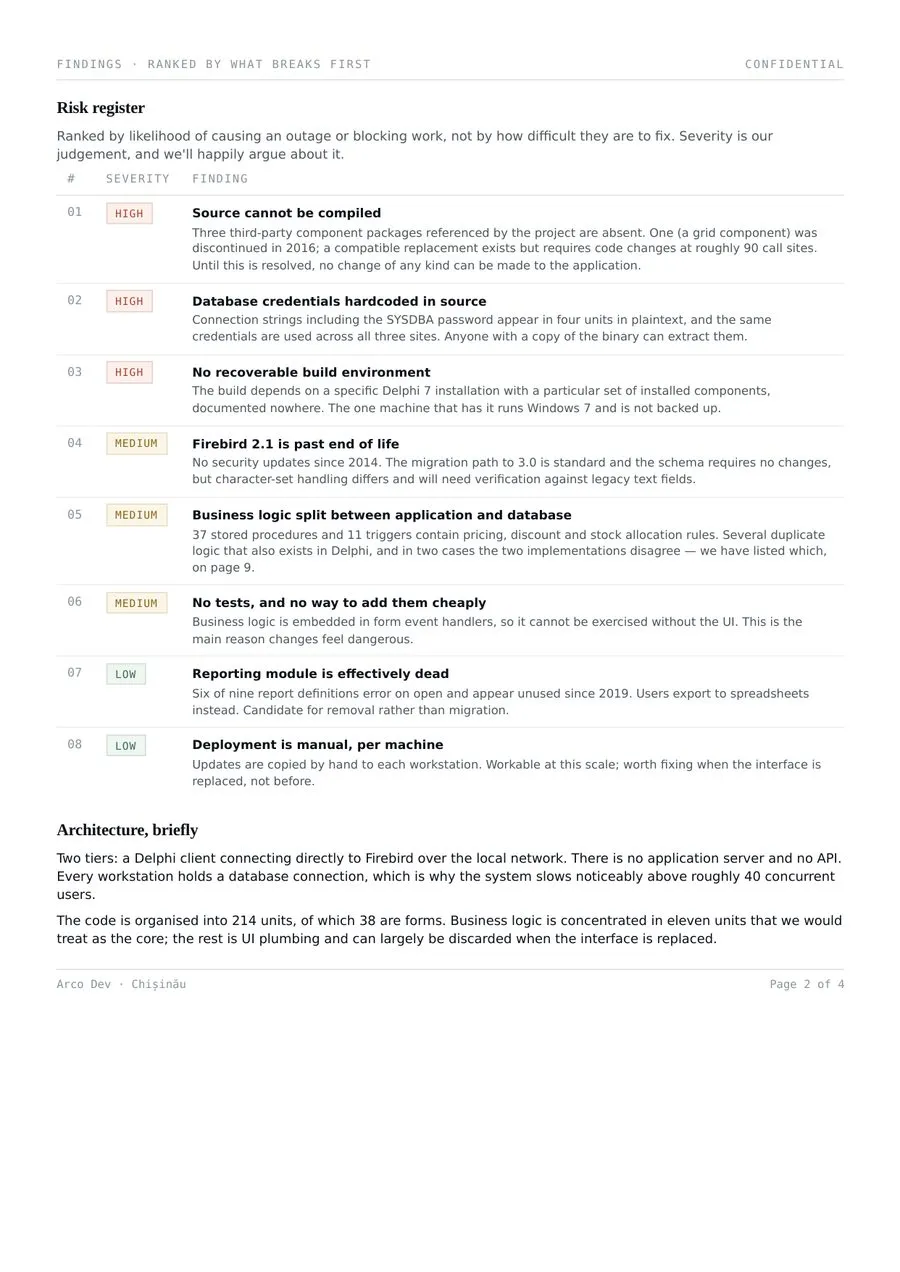
Risk register page listing findings by severity
Risk registerRanked by what breaks first, not by difficulty
Three costed options page with assumptions listed
Three options, costedWith every assumption written beside the number

If the honest answer is “this needs less work than you feared,” that’s what the report says. About a third of the time, it does.

The process

“What do you need from me, and how much of my time does this take?”

Roughly three hours of your time across two weeks. Most of it is the first call and the last one.

Day 0

A 20-minute call, no slides

You tell us what the system does, how old it is, who built it and where they went. We tell you honestly whether this is something we can read. If it’s a stack we don’t know, we’ll say so and point you somewhere better — that happens.

Day 1

Paperwork and access

Mutual NDA signed before you send anything. Read-only repository access, and store or server access where relevant. One document set, no negotiation theatre.

Days 2–4

We try to build it

Before anything else. This is where the surprises are, and it’s the single most useful thing we do in the first week. You get a short note at the end of day 4 telling you what we found — no waiting two weeks for bad news.

Days 5–9

Reading, mapping, and asking

Architecture, dependencies, security, compliance. We’ll ask you questions in writing as they come up — usually about why something was done a particular way, since the code rarely says.

Day 10

Report delivered, then a 90-minute walkthrough

You get the document first and read it on your own time. Then we go through it together and you can push back on anything. If the estimates look wrong to you, say so — you know things about your organisation that we don’t.

Who reads your code

“Who are you, exactly?”

A small engineering team in Chișinău, Moldova. We’re new to the US and German markets, and the fixed price and short scope exist partly because of that — you shouldn’t have to take our word for anything.

Iurie Manea

Iurie Manea

Co-founder · Engineering

Twenty years shipping production software. Delphi and Firebird since 2007, native iOS in Objective-C since 2010 — including two years at Endava, now NYSE-listed. Built the official iOS apps for Burger King España and Glamour España before Arco Dev.

Vasile Lipcan

Vasile Lipcan

Co-founder · Client work

I’m not the engineer. I handle scoping, the agreement, and staying reachable for the whole engagement. My background is business development, plus enough WordPress and PHP to follow along. On anything technical, Iurie answers — that’s the reason there are two of us on your first call.

Price

One number, published, because there’s no reason to hide it.

$4,900Fixed · two weeks · no commitment after

Invoiced in EUR at the equivalent rate for European clients. Half on signature, half on delivery.

Larger or multi-system portfolios: quoted after the call.

Included

  • Build verification on a current toolchain
  • Architecture map and module diagrams
  • Language, framework and dependency audit
  • Security findings
  • Platform and compliance risk with dates
  • Three options with costed effort ranges
  • 90-day plan for the recommended option
  • One-page summary for non-technical readers
  • 90-minute walkthrough call
  • Written questions answered for 30 days after

Before you book

Questions people actually ask.

What if our codebase is a genuine disaster?

Most of them are. No documentation, no tests, dependencies that no longer resolve, a build that fails on any current machine. That’s the normal starting point, not a reason to decline.

Can you do this without touching our production data?

Yes. We work from a read-only copy of the repository and, where relevant, a sanitised database dump or schema export. We don’t need real customer records to read code, and we’d rather not have them.

What if you tell us to do nothing?

Then you’ve spent $4,900 to avoid a six-figure mistake, and you have a document that says so with reasoning attached. That’s a good outcome — it’s just not one most vendors are willing to sell you.

Do we have to hire you afterwards?

No, and there’s no clause anywhere that suggests it. If the report leads to work, we’d like to do it. If you take it to your internal team or another vendor, the report is written to be useful to them too.

Is two weeks really enough?

For a single system, usually yes — reading code for structure and risk is a different job from rewriting it, and modern tooling covers ground fast. For a portfolio of several applications, it isn’t, and we’ll tell you that on the first call rather than after you’ve paid.

Where are you, and does that matter?

Chișinău, Moldova — between Romania and Ukraine, an EU candidate country with about 26,000 IT specialists. We work a shifted schedule that overlaps 9:00 AM to 1:00 PM US Eastern.

Moldova is not at war and is not a party to the conflict. We’ve had no conflict-related interruptions and can share our continuity plan before you sign anything — it’s a reasonable thing to want to see.

Do you have SOC 2?

No. We have written security policies, role-based access control and documented offboarding, and we’ll share them. If SOC 2 is a hard requirement for a two-week read-only engagement, we’re probably not the right fit, and we’d rather say that now.

Who owns the report?

You do, outright. Mutual NDA signed before you send us anything, and we don’t reference your system publicly without written permission.
Twenty minutes. Bring the stack, the history, and what you’re afraid of.

We’ll tell you whether this is something we can read and what it would cost — or that it isn’t, and where to look instead. That happens often enough to be worth mentioning.

Book a 20-minute call

Prefer email? Send the repo link and roughly how old it is — we’ll reply with what we can tell from the outside, no charge, no call. hello@arcodevs.com